

Svolværgeita
One of the most iconic routes in Lofoten.
Svolværgeita, also known as The Goat of Svolvær, is the most famous climbing peak in Lofoten and one of Norway's most iconic summit experiences. Two granite horns stand above the town, and the gap between them is one of the best-known moves in Norwegian climbing.
Who is this for?
Anyone in good physical condition can participate. No climbing skills are required. The experience may be a challenge for those with a fear of heights, but we’ll overcome it together!
Group size
Maximum of 4 people per guide.
Equipment
We can provide everything you need, just bring appropiate cloths and shoes for the approach.
Duration
4–5 hours.
Meeting point
Svolvær
Conditions
If the activity cannot take place due to weather, we will try to reschedule. If rescheduling is not possible, a full refund will be provided. Cancelation at the latest 7 days in advance.
Safety: Please read our safety policy HERE
Price
1 pers: 4500 NOK
2-8 people: 2500 NOK each
Availability
From April to October
*If you prefer other dates or times that are not on the calendar, get in touch with us and we’ll try to make it happen.
*NOT SURE IF THIS CLIMB IS FOR YOU?
Tell us your experience and we’ll recommend the best option.
Rising dramatically above the town of Svolvær, this granite pinnacle is known for its spectacular twin horns and breathtaking views over the fjords and surrounding mountains.
Climbing Svolværgeita with a guide is the perfect introduction to multi-pitch climbing and one of the most unforgettable adventures you can have in Lofoten.
The Svolværgeita experience
We begin with a scenic 40-minute hike from the parking area up to the base of Svolværgeita, crossing classic Lofoten mountain terrain.
At the wall, your certified climbing guide will provide all equipment and a full safety briefing before the ascent.
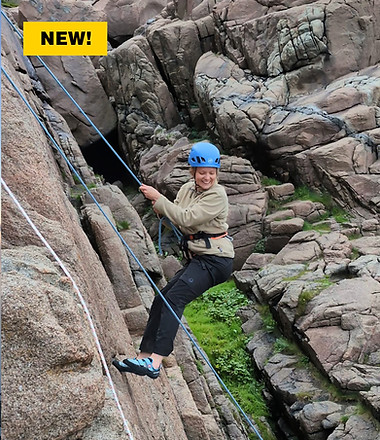
You’ll climb a classic two-pitch route to the summit, reaching the famous twin horns of Svolværgeita. From the top, you’ll enjoy panoramic views over Svolvær, the fjords, and the surrounding granite peaks.
Why climb Svolværgeita?
Climbing Svolværgeita is more than just reaching a summit.
It is:
One of the most iconic climbing routes in Norway
The most famous guided climb in Lofoten
A perfect first multi-pitch climbing experience
An unforgettable combination of adventure, exposure and scenery
Whether you are an experienced climber or trying rock climbing for the first time, Svolværgeita offers a truly unique vertical adventure.
The history of Svolværgeita
The first recorded ascent of Svolværgeita took place in 1910 by Ferdinand Schjelderup, Alf Bonnevie Bryn and Carl Wilhelm Rubenson.
This ascent became a landmark moment in Norwegian climbing history and helped establish Lofoten as one of the country’s premier climbing destinations.
Today, climbing Svolværgeita remains a bucket-list objective for climbers and adventurers from around the world.
What to bring
Clothing
Appropriate clothes depending on the weather
Windproof / waterproof jacket
Durable mountain pants
Footwear
Approach shoes or hiking shoes with good grip
Other essentials
Backpack to carry your helmet and your harness.
Water and snacks
Sunglasses / sunscreen
Technical gear
All climbing equipment is included when you book with TRAD.
FAQ about climbing Svolværgeita
Do I need climbing experience?
No previous climbing experience is required to climb Svolværgeita with a guide.
However, you should be in good physical condition, as the experience involves a steep approach hike and several hours of activity in mountain terrain.
What if I'm afraid of heights?
Many of our guests are. The exposure is real and we do not pretend otherwise, but the rope is never off you. Tell your guide at the start and we will take it at your pace.
But if you have a strong fear of heights or severe vertigo, this may not be the most enjoyable experience for you.
Can children join the climb?
Yes, children can join provided they are at least 10 years old, have a suitable fitness level, feel comfortable with heights, and are motivated for the experience.
As every child is different, we recommend contacting us in advance so we can help assess whether the climb is appropriate.
What if the weather is bad?
Safety always comes first.
If conditions are unsuitable, we will offer to reschedule or suggest alternative activities.
When is the best time to climb Svolværgeita?
The best season is from May to September, when conditions are typically dry and stable. If weather conditions are favourable and the route is free of snow, it is often possible to climb Svolværgeita in April and October as well.
Can you get up Svolværgeita without climbing?
No, it cannot be walked or scrambled. If you want the view of the Goat rather than from it, the hike to Fløya and Djevelporten looks straight across at it and is free.
Can I climb Svolværgeita without a guide?
Legally yes. There is no permit system in Norway. In practice you need to lead trad at grade 4+, place your own gear, build anchors and rig a 45-metre abseil from a small exposed summit. If that describes you, the topo is on Mountain Project and theCrag. If it does not, the reason to take a guide is the descent, not the climbing.
How long does it take to get up to Svolværgeita?
Four to five hours door to door from Svolvær: roughly 40 minutes up the Sherpa steps to the base, around two hours on the route and the summit, then the abseil and the walk back into town.
When is the season?
May to October, with June, July and August the most reliable. Under the midnight sun we sometimes start in the evening and reach the top in daylight around midnight.
Where do I park for Svolværgeita?
At the Fløya trailhead on the eastern edge of Svolvær, by the Blåtind/Nyvegen roundabout, with more parking in the surrounding streets. Central Svolvær parking is chargeable and mostly runs through the EasyPark app. In July and August the trailhead fills by mid-morning.
How high is Svolværgeita?
The formation itself is about 150 metres tall and the summit sits 356 metres above the sea, on the south-west side of Fløyfjellet just outside Svolvær.
When was Svolværgeita first climbed?
On 1 August 1910, by Ferdinand Schjelderup, Alf Bonnevie Bryn and Carl Wilhelm Rubenson. The same rope team that had made the first ascent of Stetind weeks earlier.
Book your guided Svolværgeita climb
Join us for this iconic guided climb and experience Norway’s most legendary granite summit.


Standing on the twin horns of Svolværgeita is one of the most memorable experiences in Lofoten.
Other adventures you may like



Got a question?
Drop us a line!
Contact us and let’s make your adventure happen!